
Picking a Label vs AI Discovering Your Feelings — Which Helps a Child See Themselves Objectively?
Mood check-ins ask a child to pick their own label. Seamspace is a mirror — AI discovers the emotions inside what the child has freely written, including those they didn't realize they had.
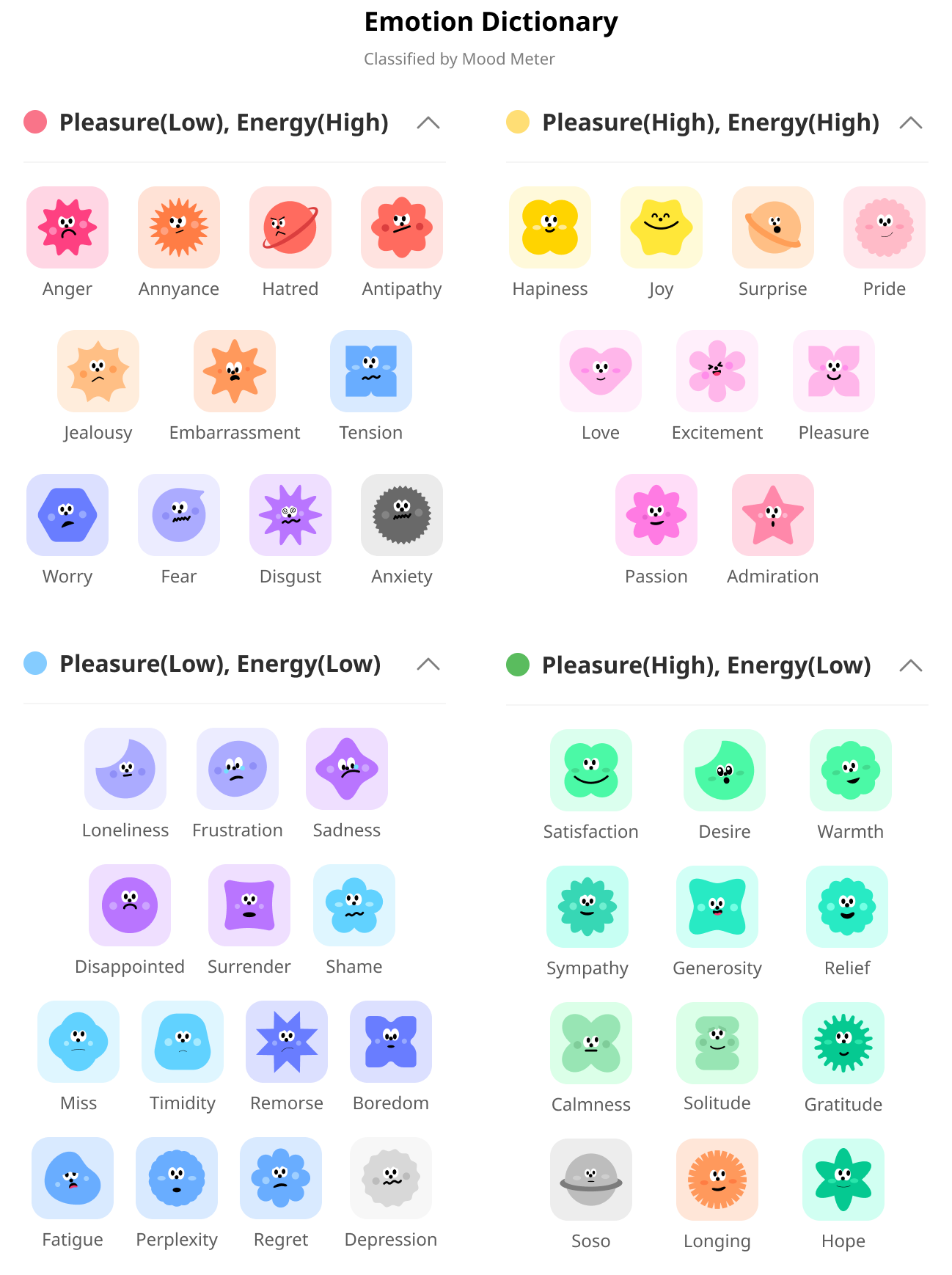
Picking a Label vs AI Discovering Your Feelings — Which Helps a Child See Themselves Objectively?
Mood check-in tools are settling quickly into schools as a lightweight way to track how students feel each day. This post looks at one role in particular — the role of mood check-in tools — alongside the role Seamspace plays: a mirror for self-objectification.
1. Where mood check-ins shine
In one minute a day, students pick from a fixed scale, five colored beans, or a set of emotion characters — choosing how they feel from a small set of visual options. The barrier to entry is low, visualization is instant, and students can participate every day without much burden.
A widely known example is Microsoft Reflect (reflect.microsoft.com), built into Microsoft Teams for Education. It uses the "Feelings Monster" character to help students name 60 different emotions, supports periodic check-ins in many languages, and ensures only educators see student responses (peer-private), with full GDPR/FERPA compliance.
Check-ins shine when a school wants "a lightweight way to visualize students' daily mood."
2. The bigger everyday — the feelings a student doesn't notice
Check-ins assume students know how they feel and can pick the accurate label. But for children whose self-awareness is still developing, this turns out to be surprisingly hard. "I just feel weird today," "I thought I was annoyed but actually I was lonely." These subtle feelings can't be picked from a 5-point scale or five colored beans.
The bigger question schools face every day is this — "How can we help students meet the feelings they don't yet notice — the ones they can't pick the right label for? Where does self-objectification begin?"
This is not the territory of label-selection. It belongs to the mirror of self-objectification.
3. Where Seamspace sits — a mirror where AI discovers feelings in what a child has written
Seamspace is not a tool for students to pick their own label. It is a mirror where AI discovers feelings inside what the child has freely written.
- Free-form writing. Students don't pick labels. They just write a diary entry. The burden of recalling the right label disappears.
- AI's discovery. AI reads the student's writing and classifies it into 46 emotions automatically. Even feelings the child didn't consciously notice get caught from the vocabulary and context of the text.
- A mirror for self-objectification. For example: "I only wrote that I was annoyed about a friend today, but the AI found loneliness in there too." The student rereads their own writing and meets their feelings with a perspective from the outside.
- Complex and contradictory feelings preserved. When several feelings coexist in one diary entry, all of them get caught. They aren't flattened into a single bucket.
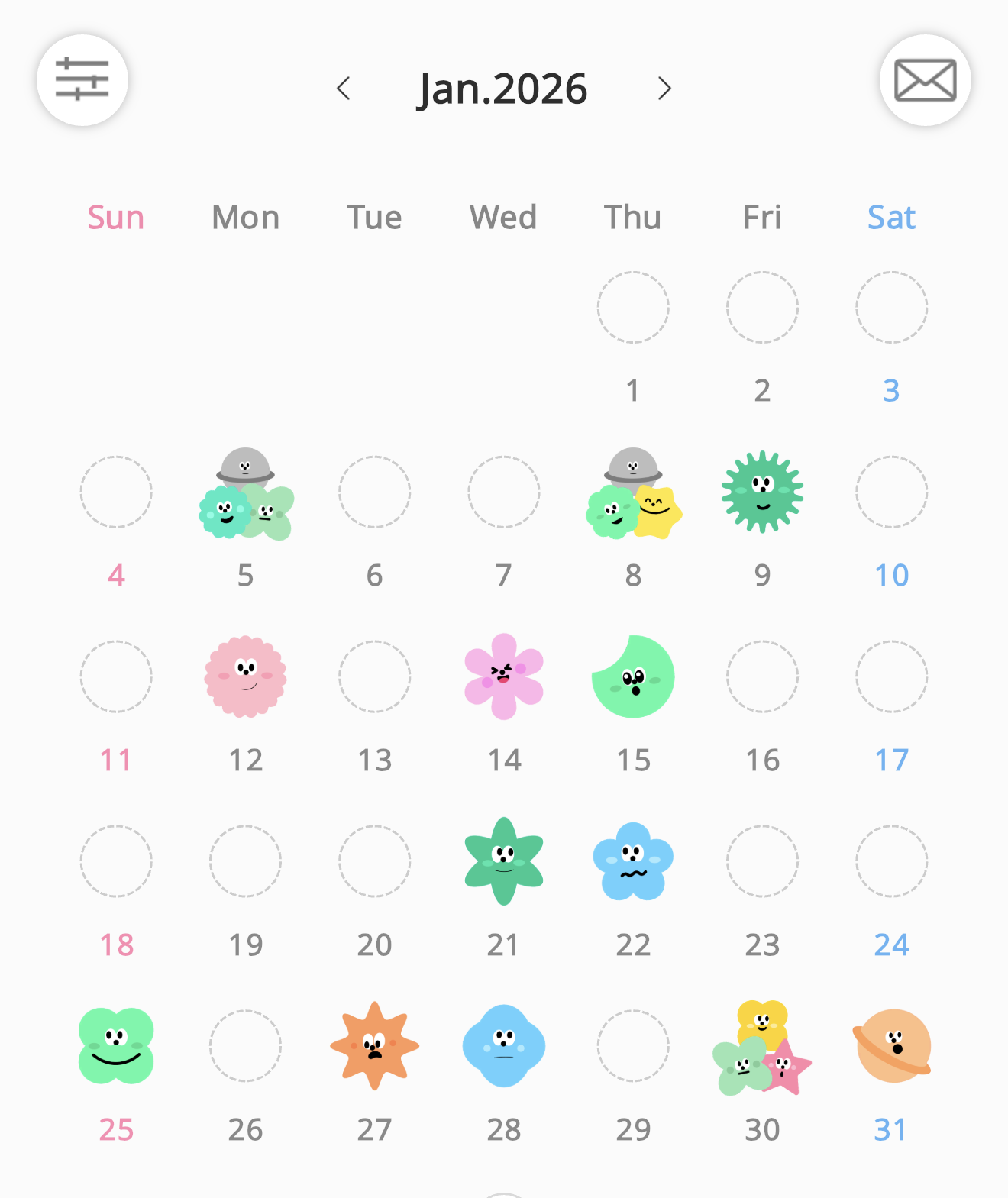
The feelings AI finds in each diary entry pile up day by day in the calendar as colors. Students see a month of their own emotional flow at a glance — a chance to see themselves from the outside.
In this space, students meet feelings they couldn't have labeled themselves.
4. Two roles, two problems — and the starting point of self-awareness
Check-in tools shine when a school wants to lightly visualize daily class mood. Seamspace shines in helping students see their own hearts objectively. Schools face both kinds of work, and the two complement each other.
But the real feelings of children whose self-awareness is still developing don't flatten into a 5-point scale. When a student writes from the heart and the AI mirrors back even the unnoticed feelings, the first step of self-awareness begins. Self-awareness starts not with labeling but with a mirror.
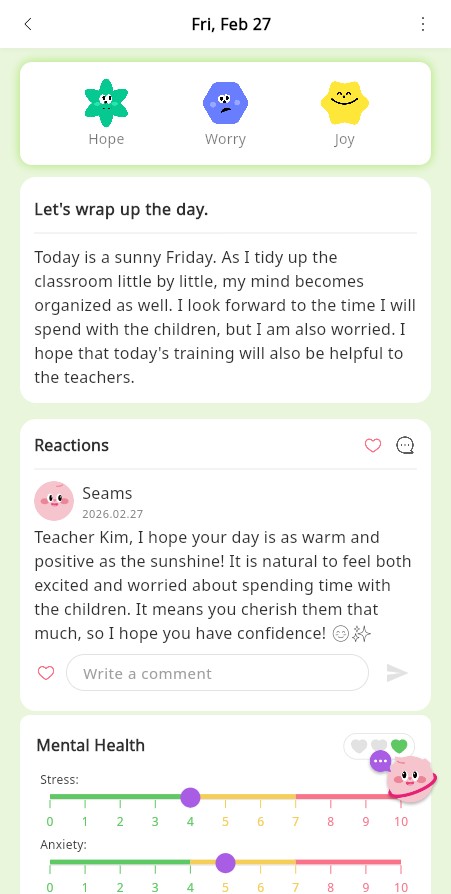
The student's writing, the emotion tags AI discovered (Hope, Worry, Joy, etc.), and the warm reply — all in one screen. A space where even the feelings you didn't realize you had are met together.
Get Started
- Teachers in Gyeongsangbuk-do and Seoul Metropolitan Offices of Education can use Seamspace free of charge until February 28, 2027 via AIEP SSO integration.
- For school adoption inquiries: www.seamspace.site